


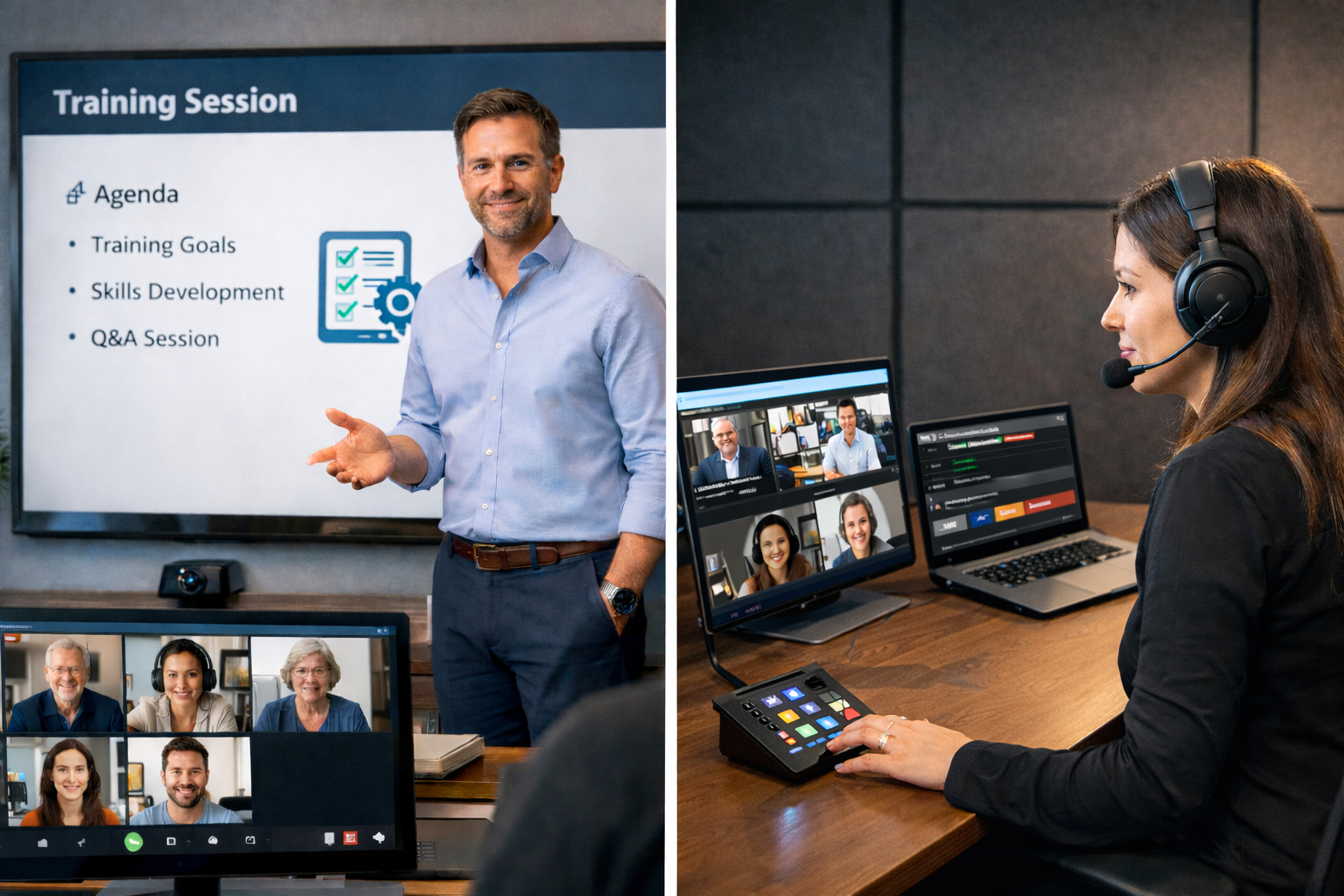
Virtual Events — Roles & Responsibilities
Short answer
You should not handle both roles at the same time. The proven solution is to use a dedicated virtual producer — ideally from a professional production company like Learngistics — who manages all technical tasks so the facilitator can stay fully focused on the audience.
Who
Who Faces This Problem?
Anyone who runs virtual meetings, webinars, online training sessions, or hybrid events eventually hits the same wall: two very different jobs need to happen at the same time, and one person is expected to do both.
The facilitator leads the conversation — presenting content, reading the room, keeping energy up, and managing the flow of discussion.
The producer manages the technology — admitting attendees, running polls, monitoring the chat, troubleshooting audio problems, and keeping the session on schedule.
These two roles compete for attention in real time. When one person tries to do both, the quality of both suffers. This affects team leaders, corporate trainers, coaches, educators, and event hosts across every industry — and the stakes are rising. [1]
of attendees expect zero technical issues during virtual events
Ticket Generator, 2024
of marketers say keeping audience attention is their top virtual event challenge
Market.us, 2025
global virtual events market size in 2025, still growing fast
Cvent, 2025
With audience expectations this high, splitting your focus between the room and the tech is no longer a manageable trade-off. It is a liability.
What
What Is a Virtual Producer and What Do They Do?
A virtual producer is a dedicated role — handled by a trained professional — responsible for all technical and logistical tasks during a live virtual session. Their job is to run everything behind the scenes so the facilitator never has to break focus.
Think of a live television broadcast. The anchor you see on screen stays fully present with the audience. Behind the cameras, a separate crew handles sound, lighting, graphics, and timing. A virtual producer is that crew — for your event.
Monitors questions and surfaces the best ones for the facilitator
Resolves audio, video, and login issues in real time
Launches interactive elements and advances content on cue
Controls the waiting room and manages participant permissions
Starts, monitors, and saves session recordings reliably
Tracks the agenda and gives the facilitator real-time cues
Research consistently shows that interactive tools — polls, Q&A, breakout rooms, and live chat — are now primary drivers of virtual event ROI and audience satisfaction. [2] But these tools only work well when someone is dedicated to running them. That person is the producer.
When
When Do You Need a Virtual Producer?
Not every session requires a dedicated producer. A small internal check-in with five to ten people can usually be managed solo. But as your event grows in size, length, or complexity, the case for a producer becomes straightforward.
A virtual producer is recommended when any of the following apply:
- The event has more than 20 attendees
- The session runs longer than 60 minutes
- Interactive features are planned — polls, breakout rooms, live Q&A
- The event is public-facing, paid, or high-stakes for your organization
- Participants are from outside your organization and may need technical support
A technical disruption during a high-stakes presentation does not just waste time. It breaks audience trust — and 88% of virtual attendees say they expect the experience to be technically flawless from the start. [3]
The more important the event, the more valuable the producer role becomes. When your content, your reputation, or your revenue is on the line, having a dedicated producer is simply good risk management.
Where
Where Should You Find a Virtual Producer — and What to Avoid
This is where many event planners make a costly mistake. There are several ways to source a virtual producer, and they are not all equal.
The freelance platform risk. Sites like Fiverr and similar marketplaces make it easy to find someone at a low price. But for a live event, the unknowns are significant. You often do not know where a freelancer is physically located, what their internet connection is like, whether their equipment meets any standard, or what happens if they do not show up. Freelancers also work alone — there is no backup, no team, and no organizational accountability if something goes wrong. [4]
Consider this
A freelancer could be working from a hotel room in a different time zone with no redundancy plan. For a live event with no replay option, that is a risk with no easy recovery.
Internal staff. A technically capable colleague can take on the producer role with platform training. This works for lower-stakes or recurring internal events where the learning curve is manageable and expectations are well understood.
Professional production companies. For events where quality and reliability matter, working with a dedicated virtual production company is the most dependable option — and the one most experienced event professionals choose.
Why a company like Learngistics is a different category
- Equipment and connectivity standards. Professional producers work from verified, high-quality setups — not a laptop on a kitchen table. Equipment standards are consistent and known in advance.
- Trained, specialized staff. Every producer has been trained on the platforms and workflows used in professional virtual events — not learning on the job during your session.
- Breadth of real-world experience. A team that supports many clients across many event types has seen — and solved — the edge cases that trip up individuals. That institutional knowledge is irreplaceable under live pressure.
- Backup producer availability. If something happens to your assigned producer, a company has people to step in immediately. A solo freelancer has no such backup.
- Scheduling flexibility. A team can cover events across time zones, accommodate last-minute changes, and support multiple concurrent sessions — something no individual producer can match.
Location and connectivity matter more than most clients realize. [5] A professional production company operates from a known, stable environment — not wherever a freelancer happens to be that day. For live events, that certainty has real value.
Summary
Key Takeaways
Facilitation and production are two separate, competing jobs. Doing both at once divides attention in ways that consistently hurt both. The answer is a dedicated virtual producer — and for events where the outcome matters, that producer should come from a professional team, not an anonymous freelance listing.
Quick reference
- Facilitators lead people. Producers manage technology. These roles have conflicting demands.
- 88% of virtual attendees expect a technically flawless experience — that standard requires dedicated focus.
- A producer is recommended for any event with 20+ attendees, 60+ minute runtime, or interactive features.
- Freelance platforms introduce unknown variables — location, equipment, connectivity, and zero backup coverage.
- A professional virtual production company brings training, standards, backup producers, and scheduling flexibility that individuals cannot match.
Sources
- Cvent. 116 Event Statistics Shaping the Industry in 2025. cvent.com
- EntrepreneursHQ. 95 Virtual Event Statistics: 2026 Trends, Growth, ROI. entrepreneurshq.com
- Ticket Generator. Key Event Statistics You Should Know in 2024. ticket-generator.com
- Business.com. The Benefits and Risks of Hiring Freelancers. business.com
- HPS Virtual Assistant. Does Location Matter When Hiring a Virtual Assistant? hpsvirtualassistant.co.uk
